Every comics reader has experienced the moment when a panel stops you cold. Not because of the story beat or the dialogue, but because of what the artist did with light. The way a sunset burns orange behind a city skyline. The way snow catches blue shadow between trees. The way the sky in the background panel is doing something that shouldn’t be possible with ink on paper but somehow is. That response to visual language, to colour and contrast and the way a scene is composed, is one of the things that separates people who read comics from people who consume them.
Rovaniemi, the capital of Finnish Lapland sitting directly on the Arctic Circle, is a place that produces that response in person. The Northern Lights move across the sky in ways that no static panel can capture but that every artist who has seen them immediately starts trying to. The winter light at this latitude is low, directional, and changes the colour of everything it touches in ways that photographers and illustrators travel specifically to study. The surrounding landscape of frozen rivers, snow-loaded forest, and open fell country looks like the reference material behind a hundred different illustrated worlds.
Here are eight reasons it belongs on the comics lover’s travel list.
1. The Northern Lights Are the Most Dynamic Natural Colour Event on Earth
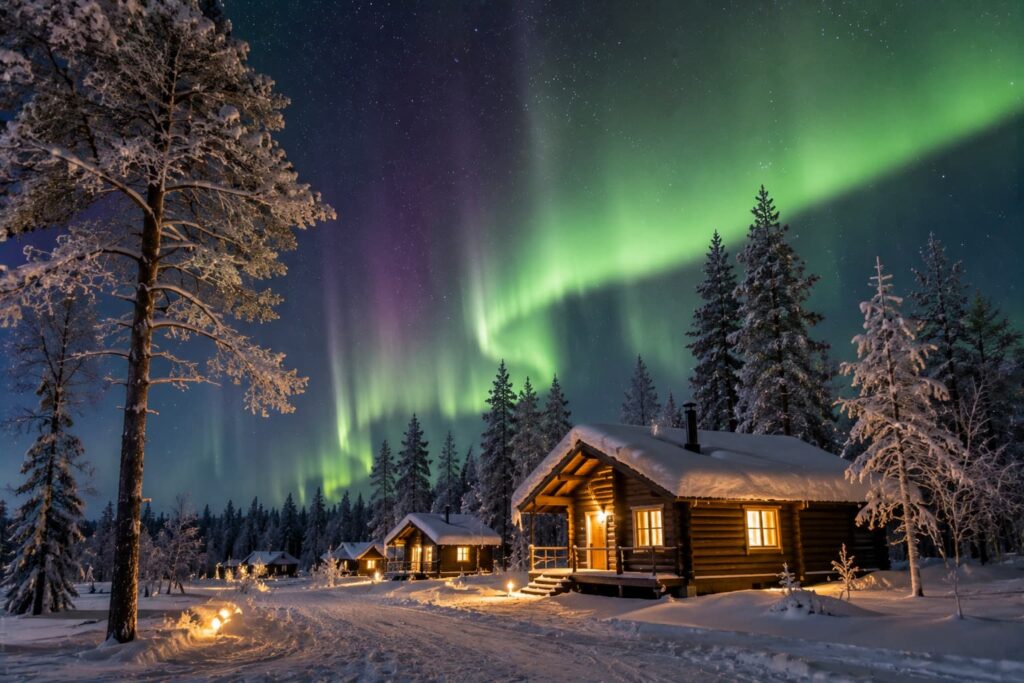
The aurora borealis is produced when charged particles from the sun interact with gases in the upper atmosphere, producing light at altitudes between 100 and 300 kilometres. The colours depend on which gases are involved and at what altitude the collision occurs: oxygen at high altitude produces red, oxygen lower down produces the most common green, nitrogen produces blue and purple. The display moves. It shifts and pulses and folds back on itself. On a strong night, the sky above Rovaniemi is doing things with colour that no fixed medium has ever fully captured.
For comics readers and artists, this matters because the aurora is an argument for what sequential art has always known: colour is not decoration. It is information. It creates mood, establishes hierarchy, directs attention, and communicates things that line alone cannot. The Northern Lights are a live demonstration of this principle at planetary scale. Watching them for the first time, most people instinctively reach for the nearest analogy, and for a comics reader, the analogy that comes first is almost always a panel, the kind where the colourist took a risk that shouldn’t have worked and did.
2. Finnish Folklore Is the Source Material for Some of the World’s Most Beloved Illustrated Stories
The Kalevala, the Finnish national epic compiled by Elias Lönnrot from oral folk poetry in the 19th century, is one of the foundational texts of Northern European mythology. It describes a world of shamans and shapeshifters, of forests with personalities, of a cosmic mill that grinds salt and gold at the bottom of the sea. J.R.R. Tolkien studied it closely; its influence on Middle-earth’s linguistic and mythological structure is documented. The visual world it describes, snow-covered, liminal, populated by beings that are neither fully human nor fully other, is the same world you are standing in when you visit Rovaniemi in winter.
Tove Jansson, the Finnish-Swedish artist whose Moomin comic strip ran from 1954 to 1975 and remains one of the most widely read comic strips in the world, drew directly on this landscape and its folklore. The Moomin valley’s relationship with seasons, with hibernation, with the darkness and strangeness of winter, reflects a specifically Finnish-Scandinavian experience of living at the edge of the habitable world. Standing in the Lapland landscape that Jansson’s family knew intimately gives the Moomin stories a different kind of legibility. The atmosphere was not invented. It was observed and translated.
3. The Visual Language of Arctic Light Is a Masterclass in Contrast and Colour
In Rovaniemi in December and January, the sun rises around 11am and sets around 1pm. For those two hours, it tracks low along the southern horizon without ever climbing high enough to produce the harsh overhead light that dominates most of the year in temperate latitudes. The result is an extended golden hour that lasts all day: long shadows, warm light on snow, cold blue in the shade, and a contrast ratio between lit and unlit surfaces that photographers describe as unlike anything available elsewhere.
For comics artists and illustrators, this light environment is a reference library. The way soft low-angle light wraps around a form rather than flattening it from above; the way blue shadow on white snow creates depth without any additional detail; the way a single light source in a dark environment simplifies a scene to its essential shapes: these are techniques that the best comic colourists use and that Arctic Lapland demonstrates in the landscape itself every winter day. The visual grammar of noir comics, with its hard shadows and pools of light in darkness, owes more to high-latitude winter light than most artists consciously acknowledge.
4. The City of Rovaniemi Was Rebuilt After World War Two by Alvar Aalto
Rovaniemi was almost completely destroyed by German forces retreating through Finnish Lapland in 1944 as part of the scorched earth campaign that preceded their withdrawal from Finland. Alvar Aalto, Finland’s most significant architect and one of the most influential designers of the 20th century, was commissioned to rebuild the city from scratch in 1945. His master plan arranged the city’s streets in the shape of a reindeer’s head and antlers when viewed from the air.
This detail sounds like something from the establishing pages of a graphic novel. It is also simply true. Walking through a city whose entire street layout was conceived as a single large illustration visible only from altitude is a different kind of urban experience, and for comics readers trained to think about panel composition and page layout as deliberate acts of design, Aalto’s city plan reads as exactly that: a composition decision made at urban scale. The Arktikum museum, also designed by Aalto, holds one of the better collections of Arctic history and natural science in Scandinavia and provides the contextual depth that turns a walk through the rebuilt city into a legible story.
5. Reindeer Herding Culture Is Living Mythology
The indigenous Sámi people of northern Scandinavia and Finland have maintained reindeer herding traditions for centuries, and in the Lapland region around Rovaniemi those traditions are still active rather than preserved as heritage display. Reindeer herds move through the winter landscape on seasonal migration routes that have been used for generations. The Sámi relationship with the landscape, expressed through a detailed ecological knowledge of snow conditions, lichen growth, river crossings, and predator behaviour, is a form of narrative intelligence about the environment that has no equivalent in written form.
For comics readers interested in how stories encode cultural knowledge about the world, the Sámi oral tradition is worth encountering with some awareness of its depth. The joik, the traditional Sámi song form that creates a unique vocal portrait of a person, animal, or place, is not unlike what comics do at their best: it doesn’t describe its subject from the outside. It attempts to express the subject’s inner character directly. The history of manga traces a similar trajectory in Japanese sequential art, where the goal was never purely narrative but the expression of mood, atmosphere, and inner states that prose couldn’t reach. Sámi cultural forms and Japanese manga arrive at the same instinct from opposite ends of the earth.
6. Guided Tours Give You Access to the Landscape That the City Alone Cannot
Rovaniemi itself is a small city of about 63,000 people, comfortable and well-serviced, with the Arktikum museum, the Pilke science centre, and a functional old town rebuilt in the Aalto style. The experience that most visitors come for, the reindeer safaris, the Northern Lights hunts away from city light pollution, the snowmobile routes through old-growth pine forest, the ice fishing on the frozen Kemijoki river, is located in the surrounding landscape rather than in the city centre.
Operators like Rovaniemi Tours structure these experiences into accessible itineraries: aurora hunting excursions timed to weather and solar activity forecasts, reindeer farm visits with Sámi guides, husky sled routes through the boreal forest, and combination tours that cover several of the key Lapland experiences within a two or three day stay. For visitors coming from outside Finland with limited winter time and high expectations, this kind of structured access to the surrounding wilderness is the difference between the city and the landscape, and the landscape is the point.
7. The Silence of the Boreal Forest Is a Creative Resource
Comics are a silent medium that creates the impression of sound. The speed line, the impact burst, the onomatopoeia panel, the held expression in a wordless sequence: all of these are techniques for suggesting experience that the reader constructs in their own head from marks on paper. That process of imaginative construction is what makes comics different from film, and it is what allows a single black and white page, at its best, to contain more sensory information than a minute of moving image.
The boreal forest of Finnish Lapland, under winter snow, is among the quietest natural environments accessible to a European or North American traveler. The snow absorbs sound. The trees are dense enough to block wind. In a clearing away from any road, on a still day, the silence is total enough to be slightly disorienting for anyone accustomed to urban acoustic environments. Spending an hour in that silence does something to the way you process imagery afterward. Artists who work in visual media without sound, cartoonists, illustrators, graphic novel writers, frequently cite periods of silence as productive for the specific kind of imaginative engagement their work requires. Rovaniemi provides that resource at scale. As our piece on where to start with comics discusses, the best entry points into the medium are the ones that help you understand what comics do that other forms can’t. The silence of Lapland is an argument for exactly that distinction.
8. Winter Activities Produce the Kind of Physical Experience That Comics Try to Convey
Comics have always tried to make you feel movement, speed, cold, and impact through static images. The wind-effect line that follows a running figure. The cold-breath panel in a winter scene. The impact star that replaces the moment of collision. These conventions are the medium’s attempt to bridge the gap between a fixed image and a lived physical experience.
A snowmobile run through Finnish forest at dusk, with the temperature at minus twenty and the tree line blurring at speed, is one of those experiences that sits in the body differently from ordinary travel. Same with a husky sled run where the dogs pull hard from the start and the only sound is paws on packed snow and your own breathing in the cold. Or the moment when the Northern Lights appear above the treeline while you’re standing in a snowfield at midnight with no artificial light in any direction. These are experiences that comics artists have been trying to put on paper for decades. Going to where they happen gives you the physical reference that no amount of visual study can substitute for, and it gives you a different relationship to the drawings that try to convey them when you come home.
A Final Thought
The best travel experiences for visual artists, whether they work in comics, illustration, painting, or any other medium, are the ones that expand the reference library that their imagination draws on. Rovaniemi expands it in specific ways that are hard to replicate anywhere else: the aurora’s colour logic, the Arctic light’s contrast ratios, the silence that sharpens visual attention, and the living mythology of a landscape that has been generating illustrated stories since Tove Jansson first put a round white creature in a dark winter forest and made half the world recognise something true in it.
That combination is worth a flight to Lapland. Go in January for the darkest skies and the best aurora odds. Stay at least three nights so the weather has a chance to cooperate. And when the lights appear, try to resist the instinct to photograph them immediately. Give yourself a few minutes to just watch what the sky is doing. The camera can come out after.
The panel in your head will be better than anything you shoot.